Pegboard is the default garage storage choice for a lot of Australian homeowners, and it’s easy to understand why. It’s cheap, it’s familiar, it’s at every Bunnings, and it looks organised on day one. The problems start at about the three-month mark.
This post documents exactly what goes wrong with pegboard in an Australian garage environment, when pegboard is genuinely the right choice, and what slatwall offers when pegboard reaches its limits. We’ve tested both systems directly — including a side-by-side comparison of pegboard and StoreWALL for power tool storage — and the results are not close.
If you just need a couple of hooks for garden tools and you’re not storing anything heavy, pegboard is fine. Read on if you have bikes, power tools, ladders, or any serious storage requirement.
What Pegboard Actually Is
Most pegboard sold in Australia is one of three types:
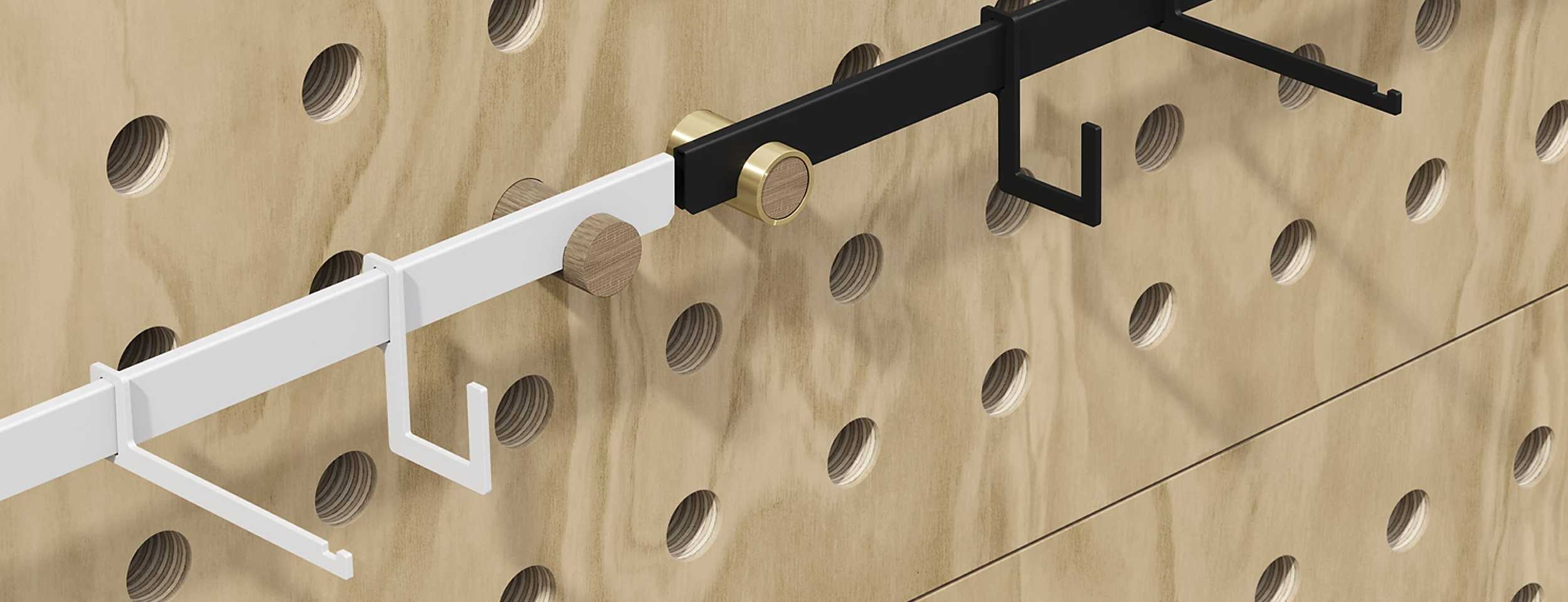
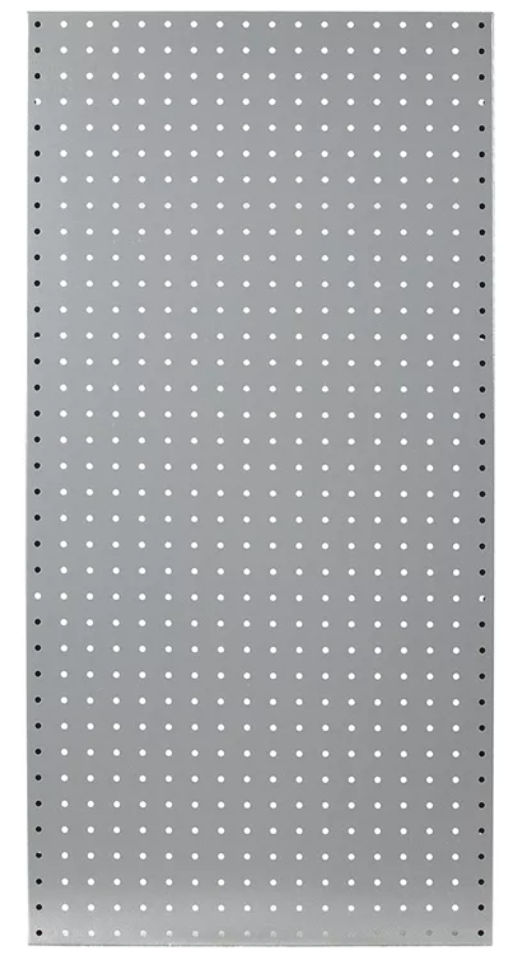
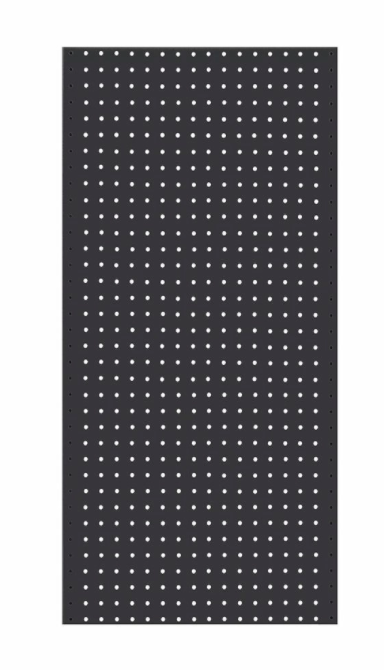
- MDF pegboard — the most common and cheapest. A sheet of medium-density fibreboard with a regular grid of 6mm holes. MDF is a wood composite that is highly sensitive to moisture.
- Metal (steel) pegboard — thinner gauge steel with a similar hole grid. More moisture-resistant than MDF but prone to surface rust in humid environments and sharper edged, which can mark stored items.
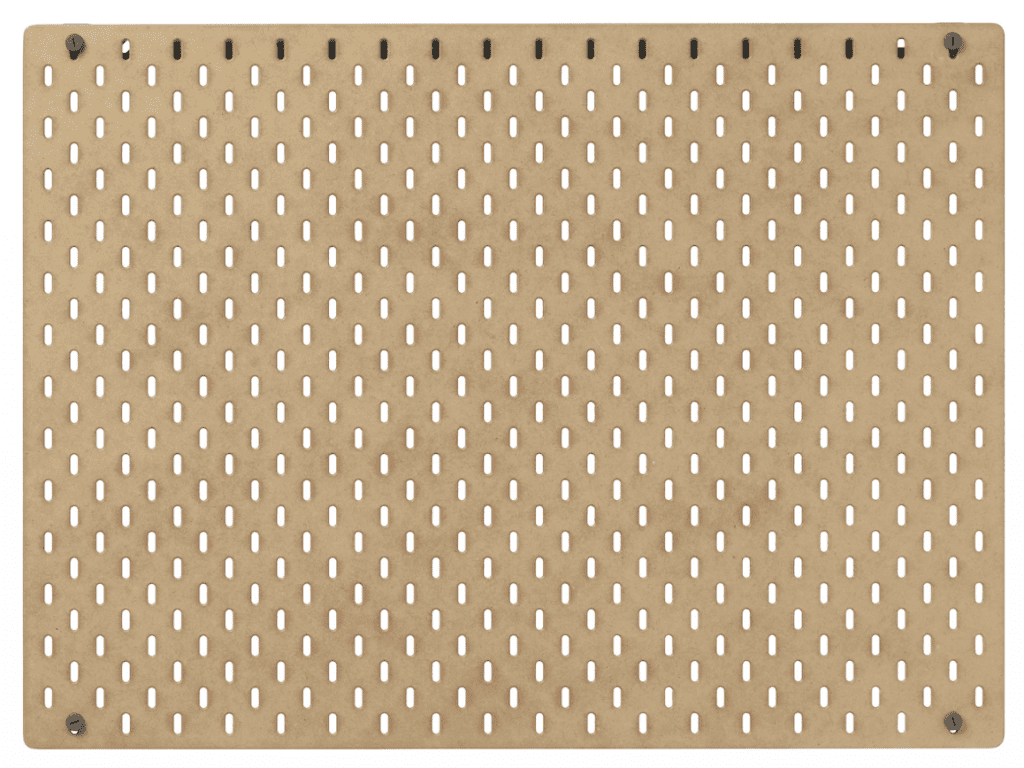
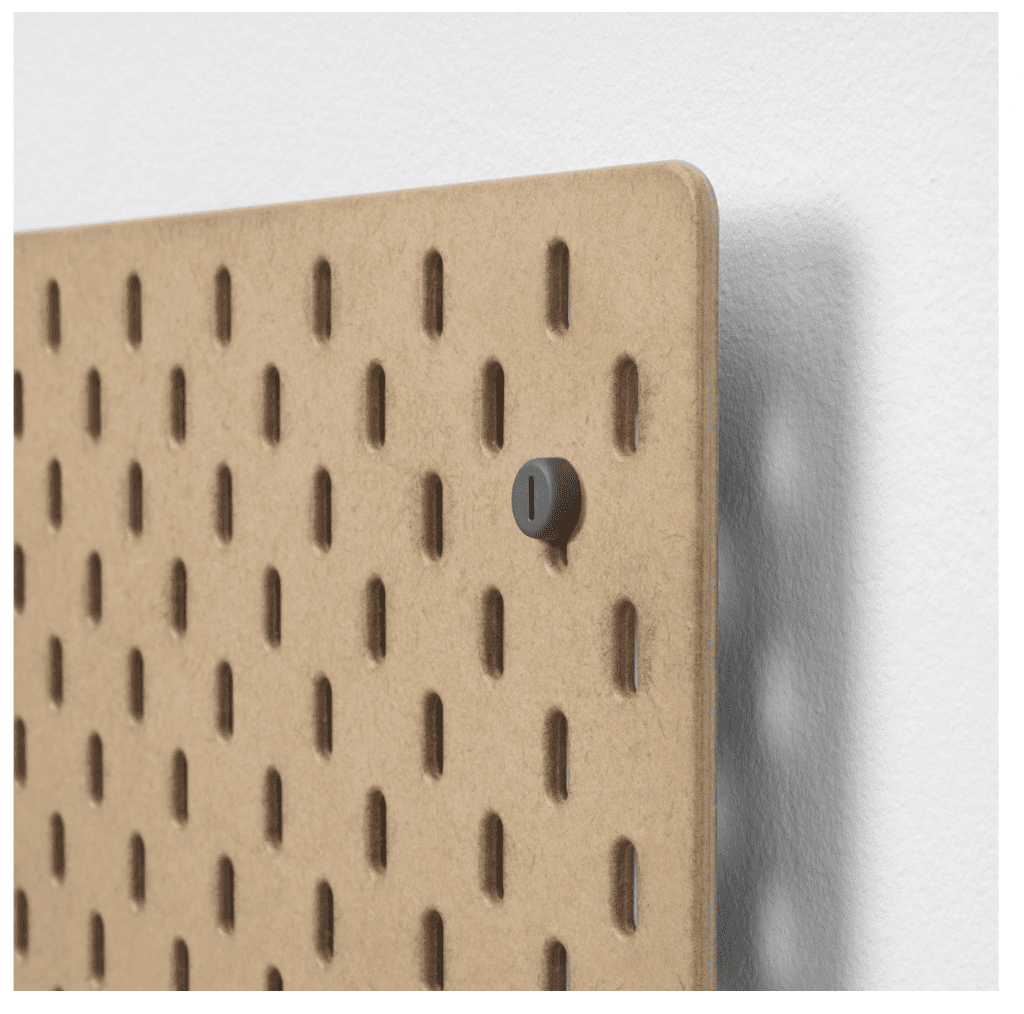
- IKEA SKADIS — a proprietary plastic pegboard system with its own range of accessories. Lighter duty than either MDF or metal, but with a cleaner aesthetic and well-designed accessory range for its weight class.
All three share the same fundamental storage mechanism: hooks are inserted into holes in the board and held in place by gravity and friction. There is no locking mechanism of any kind.
The Six Ways Pegboard Fails in a Garage
1. MDF Warps in Humidity
Australian garages are not climate-controlled environments. Summer heat, winter cold, humidity from rain and morning dew, and the occasional pressure wash all create conditions that MDF handles badly. MDF absorbs moisture, expands unevenly, and warps. A flat pegboard in November can be visibly bowed by March. Once warped, it doesn’t recover.
This is not a quality issue with any particular brand — it is a material property of MDF. Any MDF pegboard in an uninsulated garage in coastal Queensland, humid Melbourne summers, or the temperature swings of inland areas will degrade faster than the same board in a climate-controlled indoor environment.
Metal pegboard avoids this specific failure mode but introduces rust risk in coastal and high-humidity environments, particularly around the cut edges and where hooks have worn through any surface coating.
2. Hooks Fall Out
The single most common pegboard complaint, and it happens for a simple reason: there is nothing holding the hook in the hole except gravity and the friction of a loose fit. When you pull an item off the hook, the hook comes with it. When you put an item back on, the hook shifts position. Over time, the holes enlarge slightly and the hooks become even less stable.
Various solutions exist — bent wire clips, rubber anchors, adhesive dots — but all of them add complexity and cost to what was supposed to be a simple system. The underlying problem is that pegboard hooks are not designed to lock; they are designed to be repositioned, and that repositionability comes at the cost of security.
3. It Can’t Handle Serious Weight
MDF pegboard has no meaningful weight rating for individual hooks, and for good reason: the load capacity of a 6mm MDF hole with a wire hook in it is marginal. The board itself can hold reasonable distributed loads, but individual hooks under point loads — a heavy drill, a coiled hose, a beach chair — will deform the hole over time, causing the hook to tilt and eventually pull free.
Metal pegboard performs better here, but even so, there is no rated accessory for hanging a bicycle, or even multiple gardening tools with a medium weight from a standard pegboard installation. These items require a system with a structural weight rating — not a friction-fit hook in a drilled hole.
4. The Accessory Range Is Shallow
Standard pegboard accessories cover the basics: single hooks, double hooks, small shelves, small bins. What you won’t find in a pegboard accessory range: a proper bike hook rated for a 15kg e-bike, a hook for your whipper snipper, a bungee mount for surfboards, a magnetic bar for hand tools, or a heavy-duty cradle for an extension ladder. These items require purpose-built accessories that are simply not made for pegboard.
This means pegboard systems hit a ceiling quickly. You can organise screwdrivers and hang a few hoses, but the moment your storage requirements include anything larger or heavier, the system can’t accommodate it.
5. It Doesn’t Cover the Full Wall
A 900mm x 600mm pegboard covers 0.54m² of wall. A typical single-car garage wall is 3m x 2.4m = 7.2m². Covering that wall with pegboard requires 13+ boards, tiled together with visible joins. In practice, most pegboard installations cover a single section of wall, leaving the rest unused.
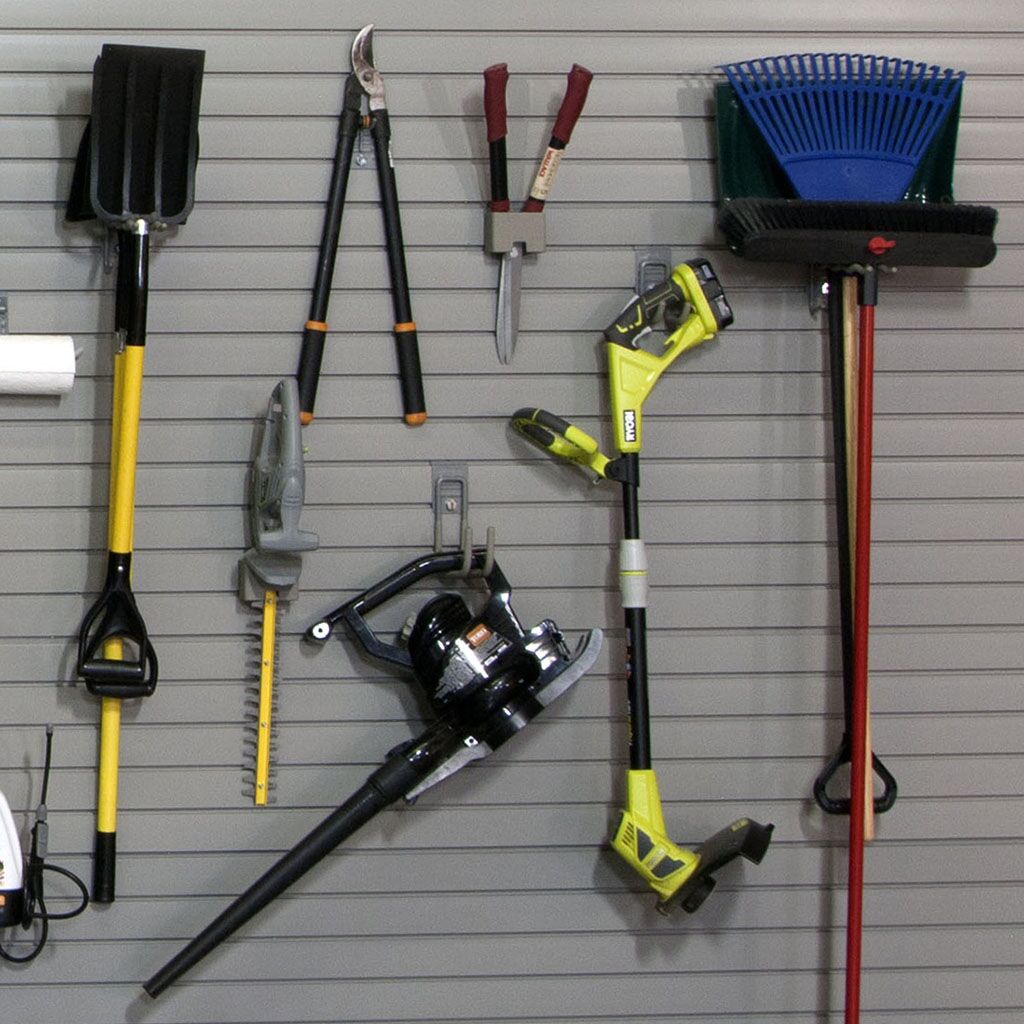
A slatwall panel system is designed to cover the full wall from floor to ceiling in a continuous, uniform surface. Every point on that wall is usable storage, not just the areas where a board happens to be fixed.
6. It Ages Badly
A pegboard installation rarely improves with age. Hooks accumulate scratches and surface rust. MDF boards swell, warp, and develop soft spots around frequently-used holes. The visual result within 2–3 years is typically a tired, patchy wall that looks less organised than it did on day one.
A well-installed slatwall system maintains its appearance indefinitely. The PVC surface is UV-stable and impact-resistant; it wipes clean; and the colour runs through the full depth of the panel, so minor surface marks don’t show through.
When Pegboard Is the Right Choice
Pegboard is genuinely the right tool in specific situations. Being honest about this matters:
- You have a single wall section in a climate-controlled room — an indoor workshop, craft room, or home office — where moisture is not a factor
- Your storage requirement is limited to lightweight hand tools: screwdrivers, chisels, small wrenches, paint brushes
- Your budget is genuinely constrained and you need a starter solution now, with plans to upgrade later
- You are a renter and cannot permanently fix anything to the walls — some pegboard systems can be mounted in temporary configurations
Outside these scenarios — particularly in an Australian garage with temperature extremes, humidity, and any serious storage requirement — pegboard is rarely the right long-term choice.
Slatwall: How It’s Different
Slatwall solves the pegboard problem at the material and mechanism level, not through workarounds. Here’s what changes:
Material
StoreWALL slatwall panels are extruded from high-density PVC — the same class of material used in plumbing pipes, and outdoor signage. PVC does not absorb moisture, does not warp or swell, does not rot, and does not rust. In an Australian garage environment, the material advantage over MDF pegboard is substantial and permanent.
Accessory Security: CamLok™
The StoreWALL CamLok™ mechanism is what makes the accessory comparison with pegboard irrelevant. Rather than inserting a hook into a hole and relying on friction, CamLok™ accessories insert into the slatwall groove and lock via a rotary cam machined from solid metal. When locked, the accessory cannot tilt, slide, or be dislodged without deliberately rotating the cam to release it.
In practical terms: a bike hook loaded with a 15kg bicycle will not move. A shelf loaded with paint tins will not tilt. A single hook holding a medium weight foldout table or multiple beach chairs will not fall out when you pull the item off it. This is the functional difference that separates a slatwall system from a pegboard at the accessory level.
Weight Capacity
StoreWALL Standard Duty panels installed with InstallStrips are rated to 113kg distributed load per 2438mm panel. Individual accessories like the Universal Hook are rated to 45kg. These are engineering specifications with a structural basis, not marketing estimates.
Pegboard has no comparable system-level weight rating because the friction-fit mechanism doesn’t support one.
Accessory Range
StoreWALL offers 24+ hook and accessory types specifically designed for the full range of garage storage requirements — including bike hooks, kayak brackets, bungee mounts, magnetic bars, and heavy-duty ladder hooks. Every accessory uses CamLok™ and is rated for the loads it is designed to carry.
 The Price Comparison: Honest Version
 The Price Comparison: Honest Version
Pegboard is cheaper upfront. This is true and worth acknowledging directly. A 900mm x 450mm pegboard with a pack of hooks costs under $50. An equivalent area of StoreWALL panels with a few hooks costs more.
The honest long-term comparison looks different for three reasons:
- Replacement cost. MDF pegboard in a garage environment typically needs replacement within 3–5 years due to warping and hole degradation. StoreWALL panels carry a 5-year warranty and are designed to last the life of the installation. The replacement cycle matters when calculating total cost.
- Capability ceiling. If your storage needs grow beyond what pegboard can support — and for most households, they do — you will eventually replace the pegboard system anyway. The cost of the pegboard installation becomes a sunk cost, not a saving.
- Accessory quality. Pegboard hooks are cheap because they are lightweight and carry no locking mechanism. CamLok™ accessories cost more because they are machined from heavier steel and include a precision locking mechanism. The per-hook price difference reflects a functional difference, not a margin difference.
If your requirement is genuinely limited to a few lightweight tools in a dry environment, pegboard is cost-effective. If your requirement includes bikes, power tools, ladders, or full wall coverage, the cost of a proper slatwall system is justified by the capability gap.
Side-by-Side: Pegboard vs StoreWALL
|
Feature |
Pegboard (MDF/Metal) |
StoreWALL Slatwall |
|
Material |
MDF (warps) or thin metal (rusts) |
High-density PVC — waterproof, impact-resistant |
|
Hook locking |
None — friction only |
CamLok™ — mechanical rotary lock |
|
Hooks fall out? |
Yes — common complaint |
No — mechanically prevented |
|
Weight rating |
Not rated (friction-limited) |
113kg per panel / 45kg per Universal Hook |
|
Suits bikes/ladders? |
No |
Yes — dedicated accessories |
|
Waterproof? |
No (MDF) / Partially (metal) |
Yes |
|
Full wall coverage? |
Limited by board size |
Yes — panels stack floor to ceiling |
|
Colour options |
White, brown, silver |
7 colours (Standard Duty) |
|
Lifespan in garage |
2–5 years (MDF) / longer (metal) |
10+ years — 5-year warranty |
|
Upfront cost |
Lower |
Higher |
|
Long-term value |
Low — replacement cycle adds cost |
High — single investment |
Frequently Asked Questions
Can I use StoreWALL accessories on my existing pegboard?
No. StoreWALL CamLok™ accessories are designed for the specific groove geometry of StoreWALL slatwall panels. They are not compatible with pegboard hole patterns or with any other wall storage system.
Is metal pegboard better than MDF pegboard for a garage?
Yes, in the sense that it won’t warp in humidity. However, metal pegboard shares all other pegboard limitations: friction-fit hooks, no weight rating for heavy items, no dedicated bike or ladder accessories, and a limited accessory range. It is a more durable version of the same system, not a fundamentally better one.
What about IKEA SKADIS — is that better than standard pegboard?
IKEA SKADIS has a well-designed accessory range for its weight class and a cleaner aesthetic than MDF pegboard. It is best suited to dry indoor environments (home office, craft room, kitchen) where loads are light. For a garage with tools, bikes, or heavy equipment, SKADIS is undersized for the task.
Can pegboard hooks be made to stay in place?
Various aftermarket clips and adhesive solutions exist that help keep pegboard hooks in their holes. Some pegboard hooks also come with screws to fasten them to the board. They add cost and complexity and address the symptom rather than the cause. In our testing, they improve hook stability but do not match the security of a mechanically-locked system like CamLok™ under sustained or dynamic loads.
How much does it cost to replace pegboard with StoreWALL slatwall?
The cost depends on how much wall area you want to cover and which panel type you choose. Use the StoreWALL Storage Calculator on the website to enter your wall dimensions and get a panel count and cost estimate. StoreWALL also offers a quote service if you prefer to send your dimensions directly.
Is StoreWALL available at Bunnings?
No. StoreWALL is sold exclusively through storewall.com.au and ships Australia-wide. The slatwall product available at Bunnings is StorEase, which uses a different rail-based system and standard friction-fit accessories rather than CamLok